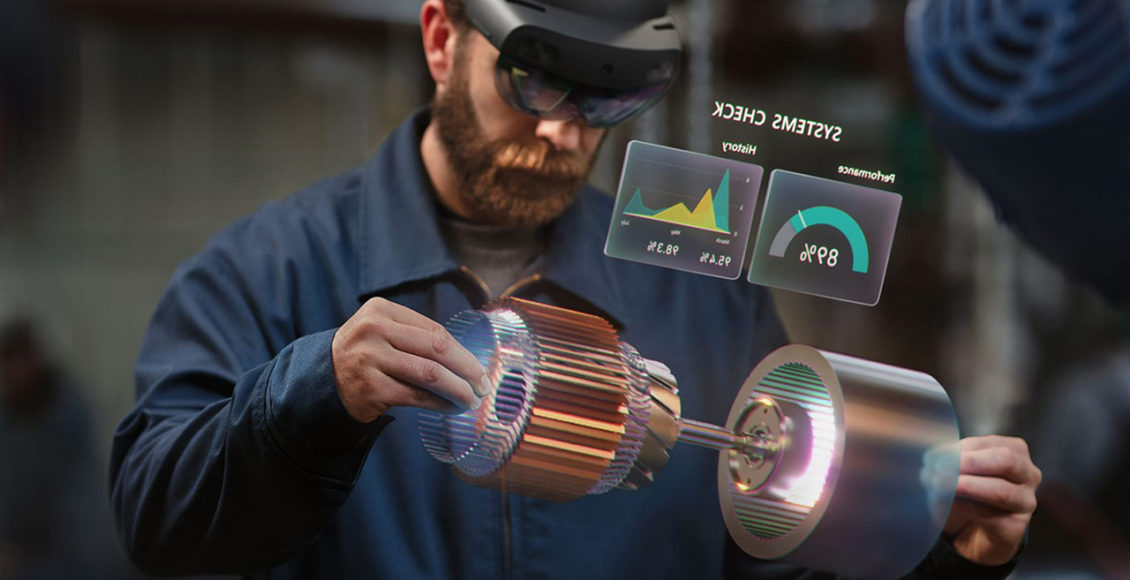
When it comes to the augmented reality (AR) market there’s currently a very definitive split between consumer and enterprise. Mostly, consumers main access to AR is through their mobile devices with an ever-growing library of games and apps available. On the enterprise side, you’ve got the likes of Microsoft HoloLens 2, providing high-end holographic interfaces designed for workplace collaboration, training and other use cases. But as Microsoft’s Alex Kipman recently confirmed, the plan is to make a consumer HoloLens.

Kipman recently spoke with Wall Street Journal’s Joanna Stern about its AR (or mixed reality (MR) if you prefer) plans and how he envisions the technology’s future. Whilst this includes shared experiences enabled by Microsoft Mesh, getting the tech into more hands (and onto faces) is an important factor and one which Microsoft is working towards by developing a consumer version of HoloLens.
“We are ‘playing’ to lead mixed reality in the world,” Kipman responded. “But you don’t get to lead a new medium of computing if you’re not going to be in consumer. So, we are absolutely working on a consumer journey for HoloLens, I’m happy to confirm that and say that it’s a very important part of our strategy.”
Just don’t expect a budget-friendly HoloLens in your local tech store anytime soon because Microsoft isn’t going to rush it. “I don’t think the technology today, goggles at $3,500, is a consumer product,” Kipman continues. “It’s an amazing product and a transformative product for the industries we’re in, but it’s not a consumer product. As soon as we can get a proper level of immersion, and immersion is key, you can’t go give some lightweight notifications in Google, put it in a device on someone’s face and assume that’s a consumer product. You need the HoloLens 2 plus, plus-level of immersion in socially acceptable glasses.”

That would mean reducing the size of HoloLens dramatically from its current form factor. Kipman estimates the HoloLens 2’s current 500g+ weight would have to come in under 90g to be a viable consumer product. Considering the amount of hardware built into the device is a sizeable task.
In the short term, that gap is going to be bridged by smart viewers. Qualcomm showcased its XR1 AR Smart Viewer Reference Design earlier in the year and devices like the Nreal Light are now coming to market. They get around some of the technological hurdles by plugging into smartphones which provide all the processing power. Qualcomm envisions this will eventually become wireless to remove the adoption friction a cable creates.
When Microsoft does make a consumer HoloLens expect Pokemon GO – or a version of it – to be on it. During Microsoft’s Ignite event, Niantic CEO and Founder John Hanke demoed a proof-of-concept providing a tantalising look at what’s to come.
Quelle: