Abstract
Introduction: Active learning methods have accumulated popularity due to improved results in knowledge acquisition as opposed to passive learning methods. For surgical resident physicians with limited training opportunities outside of the operating room due to time constraints, virtual reality (VR) is a relatively inexpensive and time-efficient active training method for procurement of surgical skills. We conducted a simulated intramedullary nailing (IMN) of a tibia to demonstrate VR training programs as a more effective modality of learning orthopedic surgical techniques compared to passive learning tools such as a standard guide (SG) through trained novice medical students performing a SawBones simulation of intramedullary nail fixation.
Materials and methods: First and second-year medical students without prior experience of procedure were recruited and randomized to SG or VR training. Participants were observed performing simulated tibia IMN procedure immediately after training and evaluated by a blinded attending surgeon using procedure-specific checklist and 5-point global assessment scale. Participants returned after 2-weeks for repeat training and evaluation.
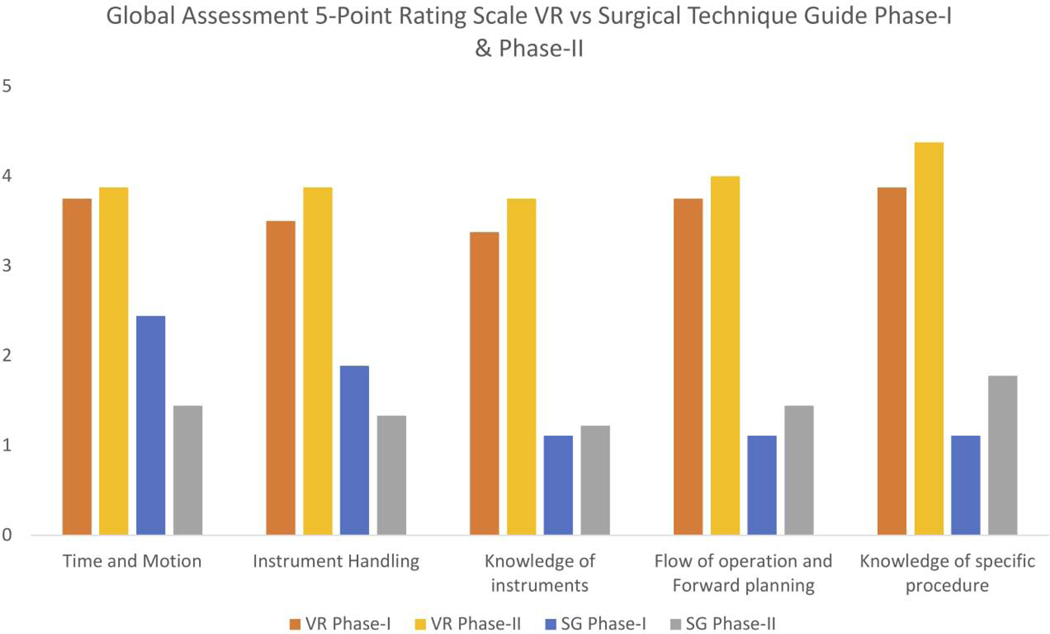
Results: 20 participants were recruited and randomized into VR (n = 10) and SG (n = 10) groups. All 20 participants completed the first phase and 17 completed the second phase of the study. Aggregate global assessment scores were significantly higher for VR than SG group (17.5 vs. 7.5, p < 0.001), including scores in all individual categories. The percentage of steps completed correctly was significantly higher in the VR group compared to the SG group (63% vs. 25%, p < 0.002). Average improvement between the first and second phases of the study were higher in the VR group compared to SG group across all 5-categories of the global assessment scale, and significantly higher for knowledge of instruments (50% vs. 11%, p, 0.01).
Discussion: VR training was more effective than a passive SG in our model of simulated tibia IMN for novice medical students. Virtual reality training may be a useful method to augment orthopedic education.
Keywords: feedback; practice; simulation; student education; training; virtual reality.
Quelle:
https://pubmed.ncbi.nlm.nih.gov/32035854/
Copyright © 2020 Association of Program Directors in Surgery. Published by Elsevier Inc. All rights reserved.