
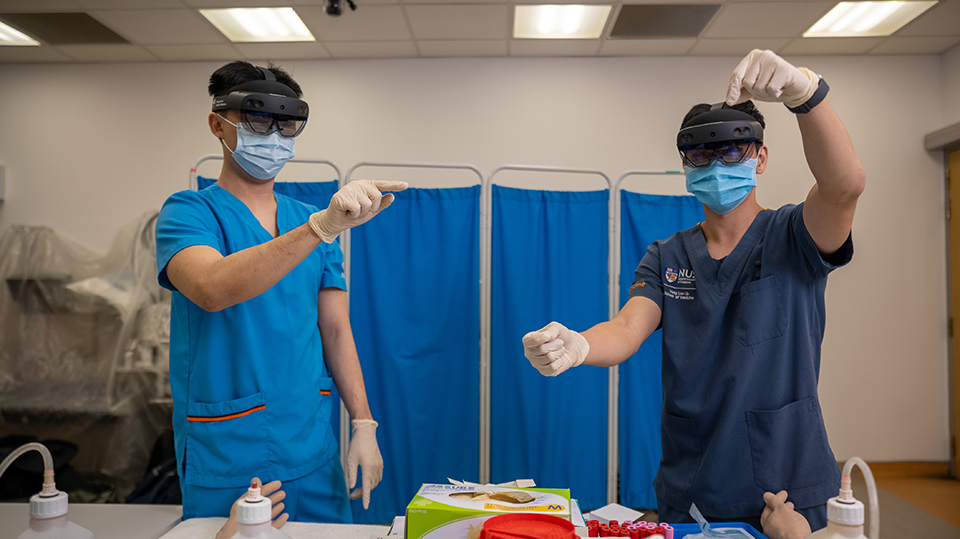
From April 2022, medical and nursing students at NUS Yong Loo Lin School of Medicine will be using three-dimensional holographic technology from Microsoft to help them learn certain medical procedures and study anatomical structures.
The collaboration, which spans NUS Medicine, the National University Health System and Microsoft, adds mixed reality to the learning experience; named Project Polaris. Through holographic technology, medical and nursing undergraduates can expect to better hone their skills through training enabled by the Microsoft HoloLens 2. This progressive use of mixed reality in healthcare education stems from Microsoft’s work with the National University Health System, which is embarking on Holomedicine research in Singapore with the aim to enhance patient care.
The medical and technical expertise of NUS Medicine and Microsoft will pave the way for the development of a niche technological competency, in which clinical training tools can be developed to introduce realistic clinical scenarios for use in medical education.
“We are continually pursuing new and innovative teaching methods to help medical and nursing students better understand the medical curriculum and gain a new appreciation for healthcare and health, while striving to maintain a balance with time-tested traditional approaches,” said Associate Professor Lau Tang Ching, the School’s Vice-Dean for Education. “This incorporation of holographic mixed-reality learning fits in well with our teaching initiatives and we hope to see this collaboration with Microsoft flourish in the coming years.”
Professor Chong Yap Seng, Dean of NUS Medicine, said he looked forward to the impact that technology would bring to medical education, “I’m glad to see that our educators have found like-minded industry partners to work with in educating the next generation of medical professionals. With such interdisciplinary partnerships, we are even more confident that our graduates will be future-ready clinicians.”
More details available in the press release here.
Quelle:
Photo: Microsoft Singapore and NUS Yong Loo Lin School of Medicine