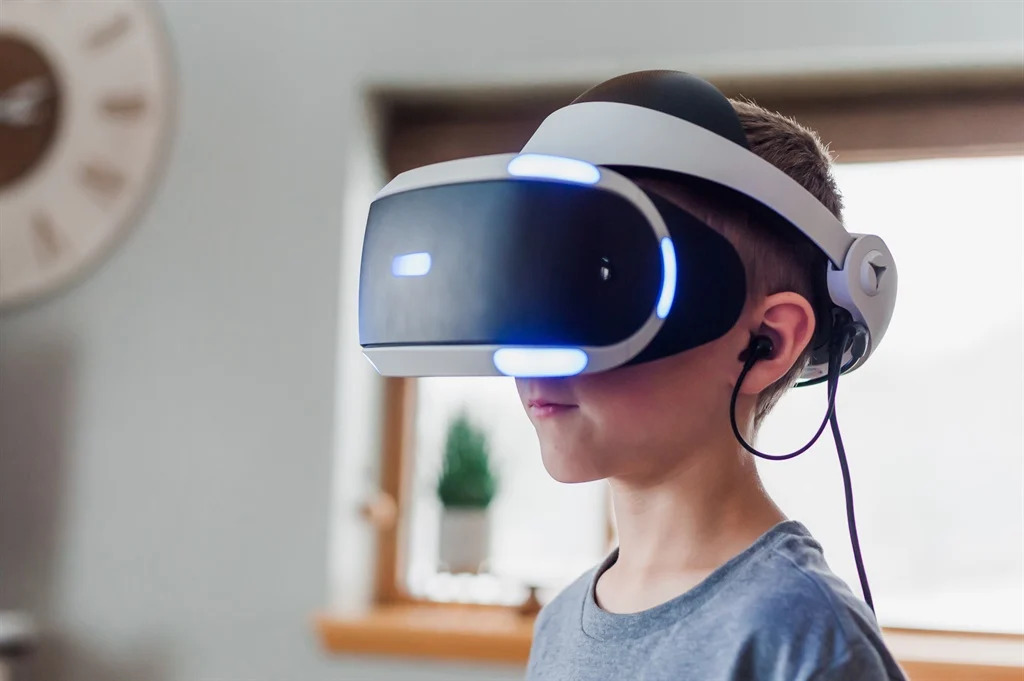
- While many associate VR with immersive gaming experiences, its application in early childhood education is an emerging field.
- Teddy Bears Montessori introduced VR into its teaching for pre-schoolers and say it has improved the learning experience.
Virtual reality (VR) technology has come a long way in recent years, and its potential for enhancing education is gaining recognition across all age groups.
While many associate VR with immersive gaming experiences or cutting-edge simulations, its application in early childhood education is an emerging and promising field.
Teddy Bears Montessori in Johannesburg recently introduced VR into its teaching.
The technology is used for children who are four years and older.
Preshanie Maharaj, the principal of the school, told News24 that today’s children seem to be „born tech savvy“ – and, because she’s always looked for innovative ways to teach, the inclusion of VR in the school was the perfect way to engage them in a fun, relevant and immersive way.
„Learners are given the opportunity to explore different places around the world and beyond, they get to see animals and other people – as if they were walking alongside them,“ she said.
„Many times it feels so real to them that they stretch out their hands to touch what they see through the VR headset. Some even get startled, that’s how real it feels.“
According to a study published in the US National Library of Medicine journal, VR has shown the ability to captivate and engage young learners.
The research found that VR had the potential to improve the way children perceive information, that it allowed them to access some environments almost impossible for them to reach, and that it could provide alternative ways of integrating information for children with disabilities.
Marjorie Nel, the sales team lead at Ulink ClassVR – a company that provides VR solutions for education – agrees, saying that the immersive and interactive nature of VR can create an environment that encourages active participation, improving memory, and maintaining the child’s attention for longer periods.
„One of the key benefits of incorporating virtual reality in early education is that it can have a positive effect on a learners‘ information retention and focus during a lesson,“ she said.
„It can also help learners come out of their shells and connect with their peers, and with their teachers in ways that they were not able to before.“
How it’s incorporated into learning
At her school – which uses ClassVR – Maharaj said they often use VR in a group setting with a teacher to supervise and guide the lesson, even though it can sometimes be used individually.
„For the little ones, we limit the viewing to approximately 10 to 15 minutes a day,“ she said.
„Depending on the topic, we usually present the lesson in the Montessori or traditional teaching method to help stimulate and engage the children’s imagination and thinking skills.“
After incorporating VR into their lessons, the school found that quieter learners would suddenly become more enthusiastic to express what they saw and experienced, with great detail and description.
Maharaj said: Including VR has not only made learning new subject material more memorable, but it has also improved learners‘ verbal communication skills, self-confidence, listening skills and observation skills.
Teachers are able to download a myriad of playlists suited for each child, class and subject.
„From viewing a human heart in the palm of your hands to exploring a specific time in history to walking on the moon – this has made teaching even more exciting for the teachers as well,“ she said.
Maharaj said their VR lessons can also include an age-appropriate mindfulness programme, which helps learners manage their emotions.
„I think that virtual reality is just what we need to bridge the gap between traditional learning experiences and technology,“ she said.
„Bringing the universe to your fingertips and making it an almost realistic experience from the comfort of the classroom.“
Quelle:
Foto: Virtual reality has the potential to improve the way children perceive information. Pexels