
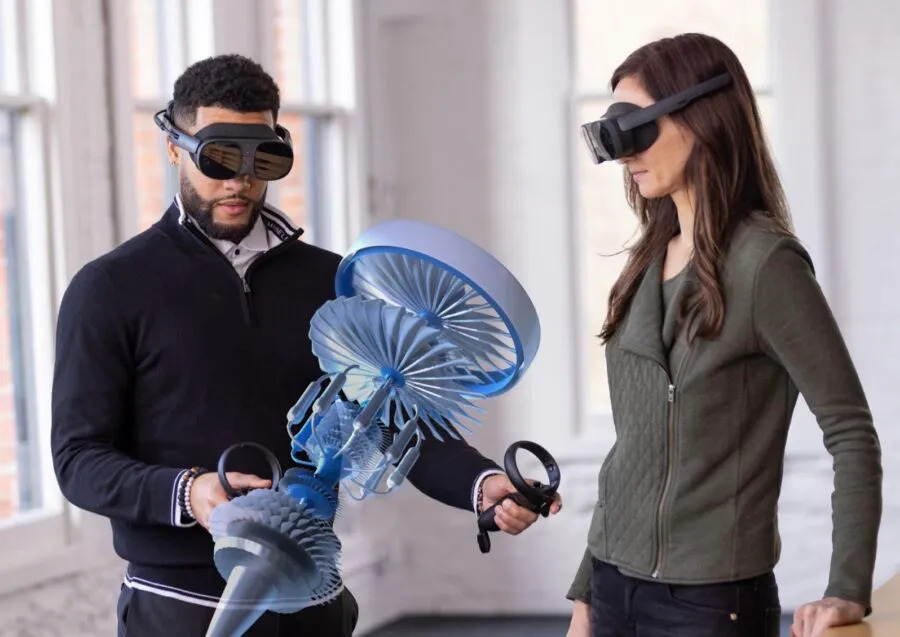
HTC VIVE has this week released a report on the use of extended reality (XR) technology by U.S. manufacturers across 10 different industries titled “The State of Extended Reality in Manufacturing.”
According to the company, the report was created from a survey of 400 professionals throughout the U.S. in various industries, from automotive and electronics to chemical and energy products. HTC VIVE stated that 75% of respondents who adopted XR saw a clear return on their investment, and 63% said it was a “seamless” experience or that it required little support.
The report also highlighted that XR technology shows particular promise in employee training, with 95% of respondents feeling safer on the job after learning the ropes in an XR-simulated environment.
According to market data research firm Mordor Intelligence the XR market is poised to grow from USD $105.58 billion in 2023 to USD $472.39 billion by 2028. HTC VIVE noted that XR offers a compelling solution for businesses of all sizes seeking to optimize operational processes, increase efficiency, reduce costs, and mitigate risks.
HTC VIVE stated that half (50%) of manufacturers surveyed for the report were already leveraging XR technology to tackle a broad spectrum of challenges across design layout and planning, quality control and inspection, design prototyping, inventory management, assembly processes, and employee training. The company added that among manufacturers that haven’t incorporated XR into their workflows yet, 59% plan to do so in the next five years, and 74% plan to do so within a decade, according to the HTC VIVE survey results.
Additional key findings from the report include:
- Among manufacturers already using XR, 70% have implemented it in training, decreasing the need for costly and potentially dangerous in-person exercises;
- XR’s use cases in manufacturing are still being discovered; 40% of respondents said they see future potential in areas such as inventory management and maintenance and repair;
- Improved training is a powerful motivator for adoption, but so is improved efficiency; 67% of companies have integrated XR for this reason;
“We’ve seen very healthy momentum of XR solutions in the manufacturing and industrial sector. Our latest report shows that broadscale XR adoption in this industry is a matter of ‘when,’ not ‘if,’” said Daniel O’Brien, GM of Americas at HTC VIVE. “Not only is XR an incredible tool for training manufacturing professionals and making them safer, it also results in significant time and cost reductions. This gives manufacturing firms using XR now or in the future a competitive advantage.”
To learn more about the use of XR in the manufacturing sector, HTC VIVE’s “State of Extended Reality in Manufacturing” report can be downloaded here.
Quelle:
Image credit: HTC VIVE