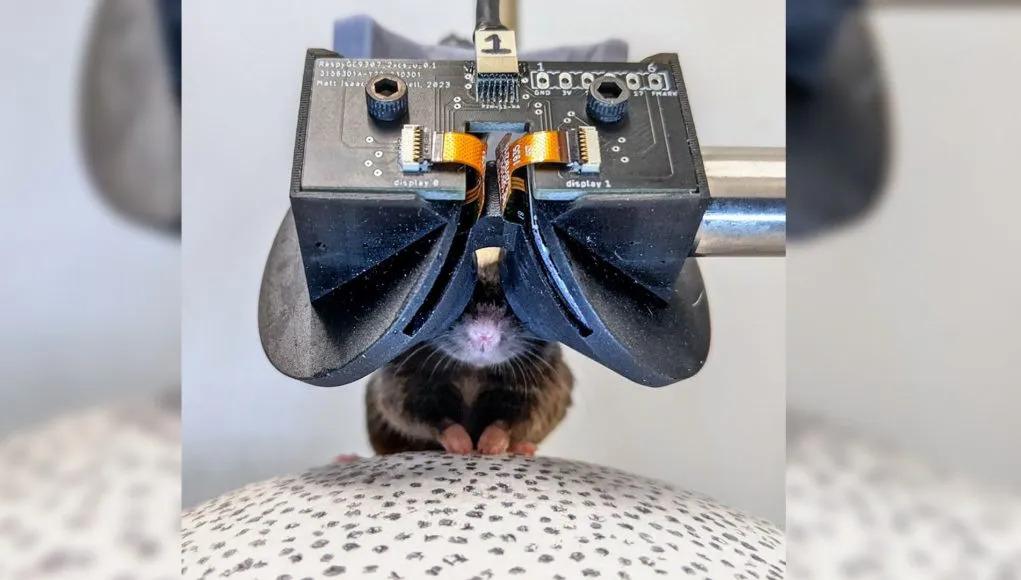
Researchers at Cornell University have developed ‘MouseGoggles’, a miniature VR headset with eye-tracking for mice, which was used to study complex behaviors during neural recordings.
Traditional small-animal VR systems have been limited by their size, immersivity, and lack of advanced features such as eye-tracking. With MouseGoggles, which was the subject of a recently published paper, Cornell researchers hoped to gain greater insight into the mouse brain, which has been the gold standard model for behavioral and neurological studies.
Researchers validated the study by recording neural activity in the visual cortex, showing that the images were presented clearly and effectively. They also found that the VR headset created an immersive experience, as demonstrated by hippocampal recordings, reward-based learning tests, and fear responses to virtual looming objects.
Led by by Chris Schaffer, professor of biomedical engineering in Cornell Engineering, and Ian Ellwood, assistant professor in neurobiology and behavior in the College of Arts and Sciences, the team also hopes to facilitate broader adoption of VR methods in neuroscience research.
“It’s a rare opportunity, when building tools, that you can make something that is experimentally much more powerful than current technology, and that is also simpler and cheaper to build,” postdoctoral researcher Matthew Isaacson told Cornell Chronicle. “It’s bringing more experimental power to neuroscience, and it’s a much more accessible version of the technology, so it could be used by a lot more labs.”
Notably, MouseGoggles were built using low-cost, off-the-shelf components, including smartwatch displays and tiny lenses, to create a compact system. The mini VR headset also relied on widely-available tools such as Godot game engine and a Raspberry Pi 4, which the team rigged with a split-screen display driver.
Ultimately, the team’s work could lead to more interest in creating lightweight, standalone headsets for larger rodents, such as tree shrews and rats. As it is, MouseGoggles are a fixed-head experience that relies on a a ball-shaped treadmill to create the illusion of movement. Researchers also hope to add sensory features like taste and smell, making the VR experience even more immersive.
“I think five-sense virtual reality for mice is a direction to go for experiments where we’re trying to understand these really complicated behaviors, where mice are integrating sensory information, comparing the opportunity with internal motivational states, like the need for rest and food, and then making decisions about how to behave,” Schaffer told Cornell Chronicle.
Quelle: