Numerous examples exist of doctors and surgeons using HoloLens to plan surgeries. The device has even been used to view reference images during a procedure and stream it to a remote audience. Until recently, it has not been used to augment the surgeon’s view of the patient during a live surgery.
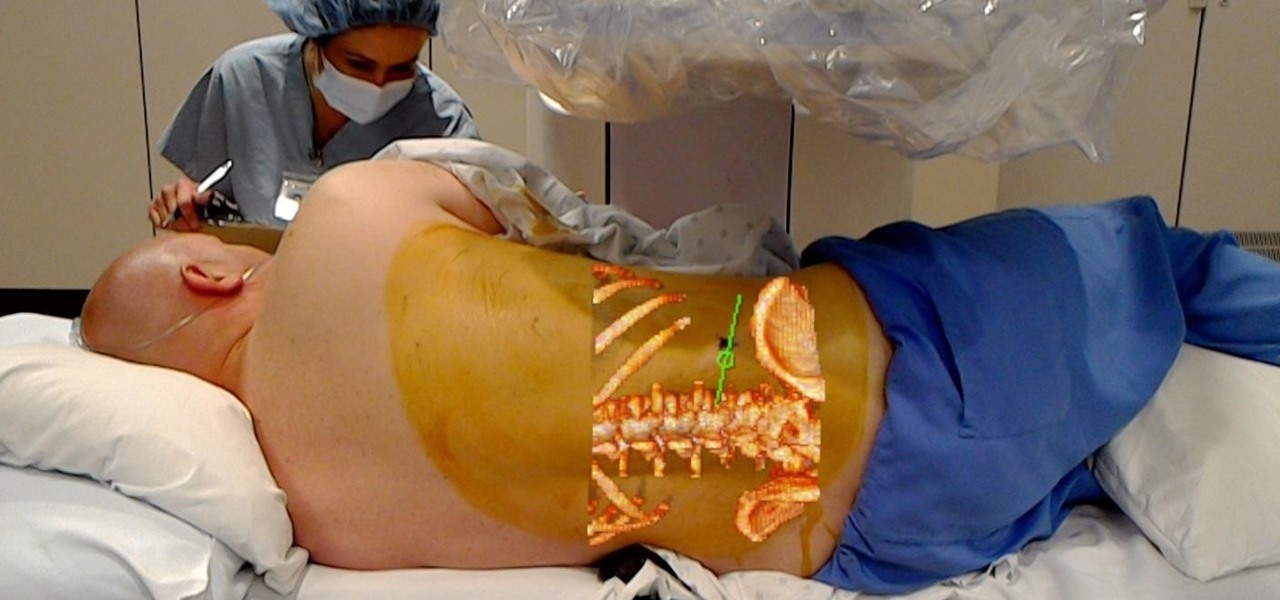
On July 9, neuroradiologist Dr. Wendell Gibby performed an automated percutaneous lumbar discectomy (APLD) using Microsoft HoloLens to assist in navigating the patient’s internal anatomy and fluoroscopic guidance to view real-time internal imagery.
„This is very new stuff. It’s the first procedure I’m aware of that has done this in the world. People have performed some work with 3D models and simulations,“ said Gibby, who also serves as CEO of Novarad Corporation, in a news release. „We had some papers recently at the American Society of Neuroradiology (ASNR) about this, but it’s the first time we’ve tried it on a patient.“
The feat was made possible by Novarad’s OpenSight augmented reality system. In development over the past year, the software renders 3D images based on MRI and CT scans of the patient, with HoloLens tracking the physical location of the scans on the patient’s body.
By having the augmented information in their line of sight, OpenSight can improve a surgeon’s accuracy and efficiency, in turn decreasing mistakes.
A company spokesperson told Next Reality that Novarad is in the process of submitting OpenSight to the Food and Drug Administration to approve use in surgery; the process can take up to six months. In the meantime, the company is in discussions with several hospitals and medical schools, while an undisclosed number of sites have the OpenSight system in place already.
A Microsoft Gold Partner, Novarad considers HoloLens to be a market leader in augmented reality and an ideal fit for the OpenSight system.
„We are using cutting-edge augmented reality to display a 3D version of a patient’s anatomy on the actual patient,“ said Steve Cvetko, director of research and development at Novarad. „It offers a true, life-size rendering with exact alignment and orientation, which is valuable for medical education, research and, of course, surgery.“
Quelle:
https://hololens.reality.news/news/hololens-assists-live-surgery-0178887/