
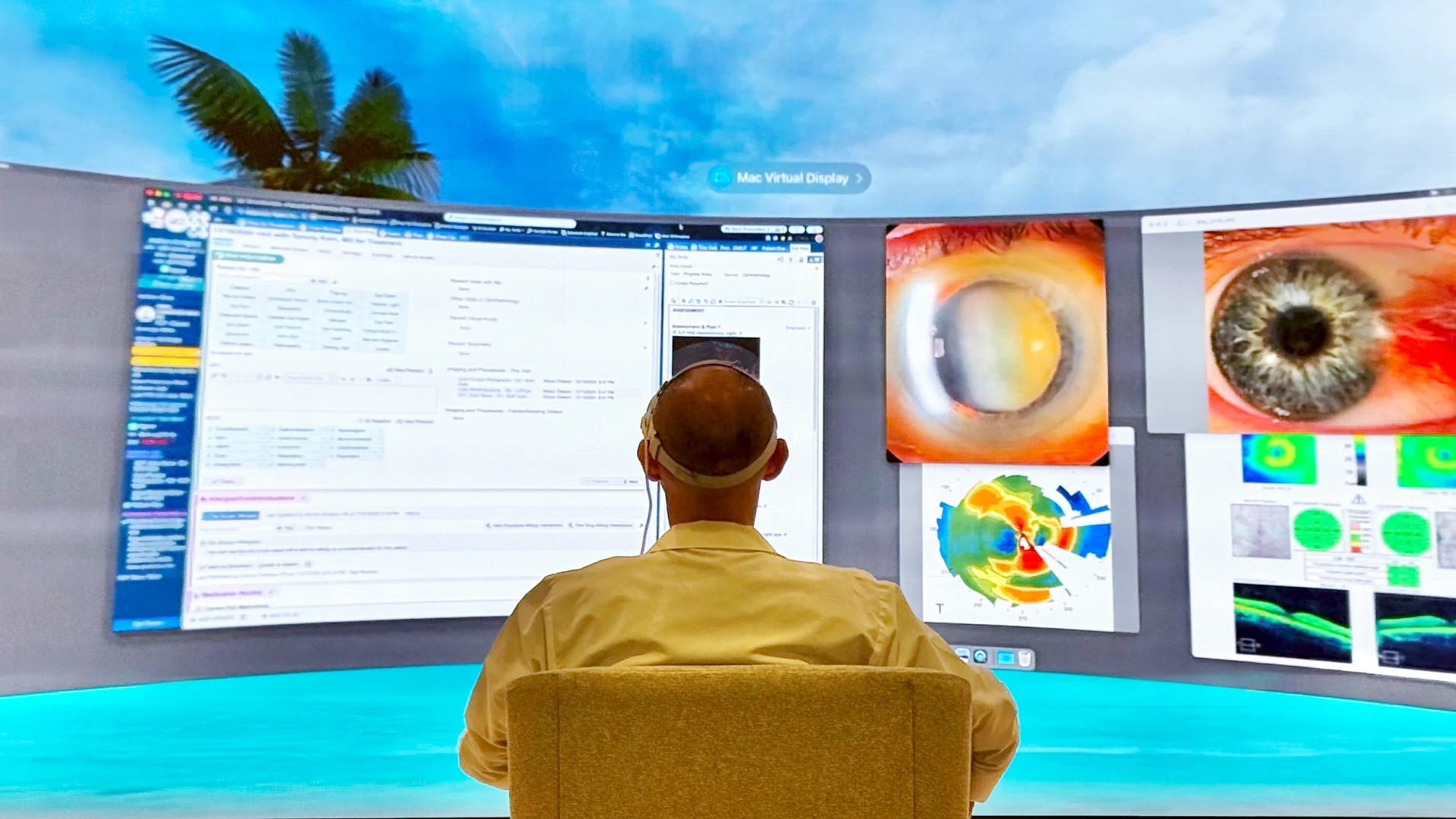
300 people are gathering in San Diego to explore the uses of Apple’s spatial computing headset for surgery and other medical applications.
In early 2024, Ryan Broderick, a surgeon at UC San Diego Health, was commiserating with some colleagues about the profusion of screens in today’s operating rooms. Though the displays provided essential guidance for minimally invasive operations in progress, they also added complexity.
“We were looking around the operating room,” he remembers. “We have a lot of monitors, a lot of clutter. We were like, ‘There’s got to be a better way to do this.’”
It wasn’t just about tidiness. ”For [a] monitor to be in the ideal position for surgery, it really should just be directly in front of your head without having to turn your neck or adjust your body,” explains Dr. Broderick. “But often in laparoscopy, you have to adjust your body, turn your neck, and be in uncomfortable positions. And with repeated use like that, it can lead to tight muscles, neck injury, back injury.”
The doctors’ frustration with this situation happened to come to a boil at an opportune time. On February 2, Apple released the Apple Vision Pro, its first headset. A major element of the device’s spatial computing experience was the ability to float multiple virtual screens of any size in real-world surroundings, unconstructed by the bulky inconvenience of physical displays. Dr. Broderick’s team got its hands on a loaner Vision Pro and worked with UC San Diego Health chief clinical and innovation officer Dr. Christopher Longhust to assemble a system capable of streaming video feeds and overlaying them on the live view of a surgery in progress, greatly reducing the need to crane necks.
In short order, the idea became a trial that involved real patients and is currently undergoing peer review. “We’ve done over 50 cases and have had great success thus far,” says Dr. Broderick.
Quelle:
Foto: courtesy of Sharp HealthCare
https://www.fastcompany.com/91269127/apple-vision-pro-healthcare