
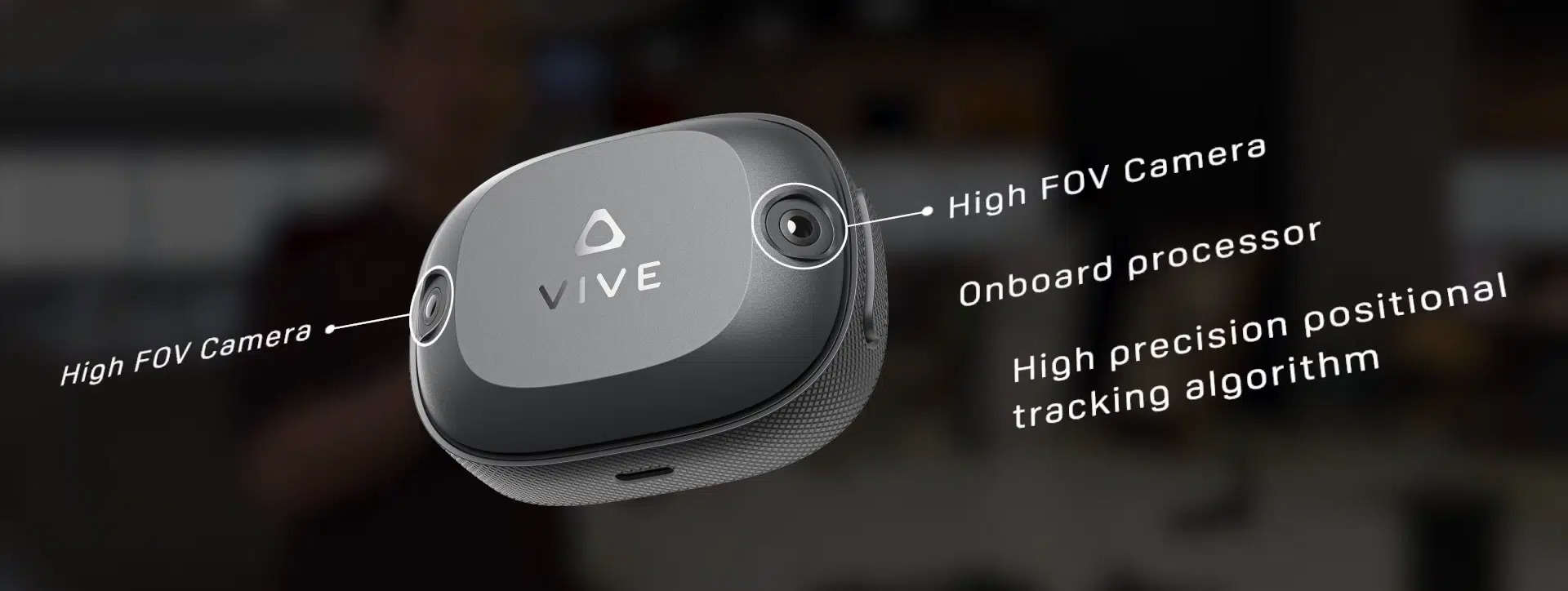
HTC teased a self-tracking Vive Tracker that doesn’t need base stations.

Vive Trackers are used by businesses in bespoke VR software to track real-world objects, and by VRChat users to track body parts such as their torso, eblow, legs, and feet.
The current Vive Tracker 3.0 shipped in 2021. It’s priced at $130 but requires SteamVR Tracking base stations, available from $135 each.
The new ‘Self-Tracking Tracker’ is set to launch in Q3 of this year. It has two wide field of view cameras and an onboard processor to perform inside-out positional tracking, like a Quest Pro controller without any buttons, triggers, haptics, or sticks. This means it doesn’t need base stations nor to be within view of a headset’s cameras.
It will connect to a specific USB-C dongle, which HTC says will support up to 5 trackers at once. It will support the OpenXR standard, so won’t require a HTC headset.

HTC claims it weighs under 100 grams and is approximately 50% smaller than Vive Tracker 3.0. However, it won’t replace Vive Tracker 3.0 – it will be sold alongside it. Typically camera-based inside-out tracking doesn’t work well in plain rooms with no high-contrast features or in low light, while base stations work in almost any environment.
Like previous Vive Trackers, it will support standard 1/4” threaded screw mounting, the same used by cameras and speakers. There’s also a new magnetically-attaching clip mount, and HTC says it will release the CAD files so people can 3D print their own mounts.
HTC says the Self-Tracking Tracker is still in the development phase and didn’t announce a price.
Quelle: