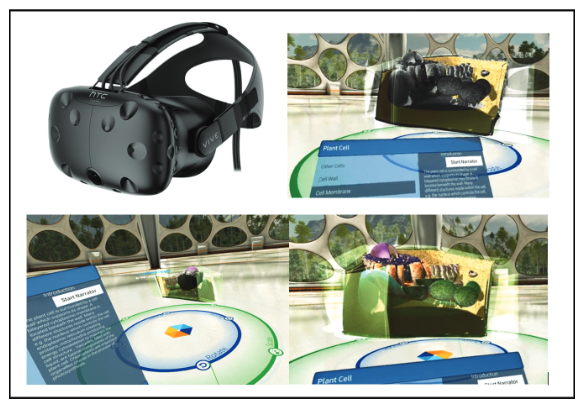
Recent advances in virtual reality (VR) technology allow for potential learning and education applications. For this study, 99 participants were assigned to one of three learning conditions: traditional (textbook style), VR and video (a passive control). The learning materials used the same text and 3D model for all conditions. Each participant was given a knowledge test before and after learning. Participants in the traditional and VR conditions had improved overall performance (i.e. learning, including knowledge acquisition and understanding) compared to those in the video condition. Participants in the VR condition also showed better performance for ‘remembering’ than those in the traditional and the video conditions. Emotion self-ratings before and after the learning phase showed an increase in positive emotions and a decrease in negative emotions for the VR condition. Conversely there was a decrease in positive emotions in both the traditional and video conditions. The Web-based learning tools evaluation scale also found that participants in the VR condition reported higher engagement than those in the other conditions. Overall, VR displayed an improved learning experience when compared to traditional and video learning methods.
Link/Quelle: