Virtual reality is a safe and effective tool for soft skills training according to a new PwC report.
It’s no secret that virtual reality is an effective tool for hard skills training and job simulations. From aviation to manufacturing, it gives trainees realistic simulations of their work stations without putting them in harm’s way. In a recent PwC study, it shows that VR also makes soft skills training more impactful.
Here, we’re going to delve into the effectiveness of VR for soft skills training. We’re going to see how it can be advantageous, especially in our ever-changing workplace environment.
How Effective Is Virtual Reality in Soft Skills Training?
Businesses need to come up with innovative solutions to thrive in the midst of a global health crisis. In times when leadership, adaptability, and problem-solving are sought-after skills, there’s also increasing interest in VR’s capacity to conduct soft skills training.
So is VR a valuable tool for soft skills training?
PwC conducted a new study, “The Effectiveness of Virtual Reality Soft Skills Training in the Enterprise”, to answer this very question. Their respondents were new managers from 12 US locations. They went through the same inclusive leadership training in one of three methods—classroom, e-learning, and v-learning.
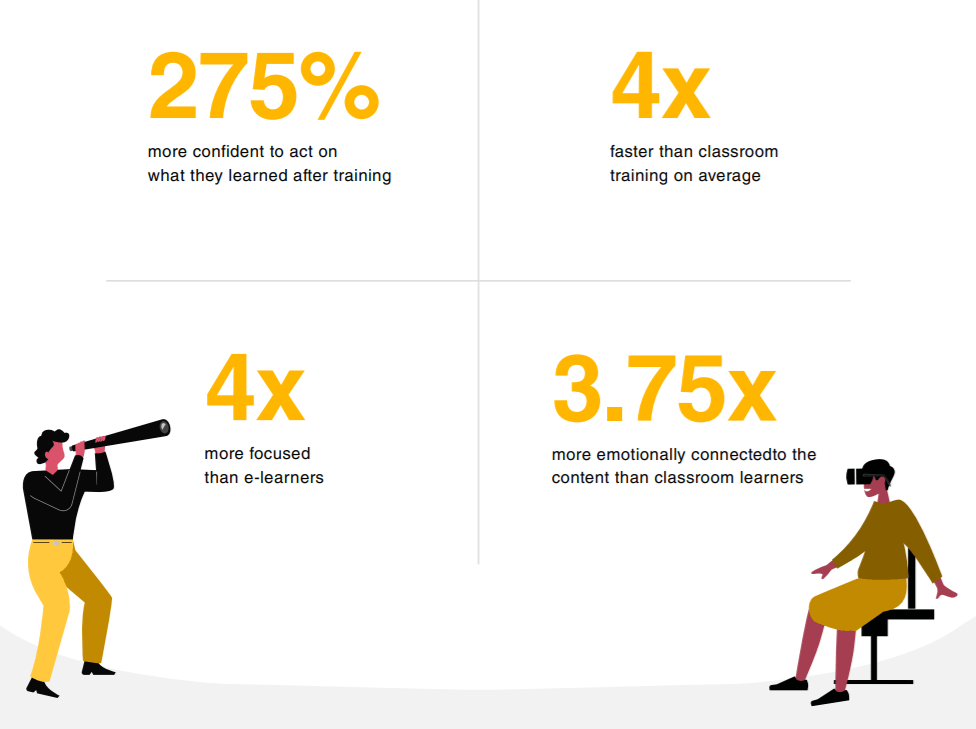
The study revealed that VR learners were four times faster to train than classroom learners. They were four times more focused than e-learning trainees. Moreover, they were 3.75 times more emotionally connected to their educational material compared to classroom learners.
In terms of skills application, VR learners were 275% more confident than the rest of the respondents in the study. Consequently, this demonstrates how VR has a place in the modern workplace. Businesses can use it to empower employees to gain critical soft skills.
Is Virtual Reality Soft Skills Training Practical?
In the same study, PwC found that VR can be a cost-effective solution for soft skills training. A few years ago, this wasn’t the case. However, the widespread availability of VR headsets has made immersive technologies more accessible.
Just like other tools and equipment, businesses can use these devices repeatedly for training purposes. More and more studios are also creating VR content. Additionally, vendors are crafting software packages for non-VR developers so that they can develop their own VR programs even without a massive budget.
While its cost has dropped over the years, it still requires about a 48% greater investment than classroom or e-learning. A virtual headset ecosystem can cost up to $1,000. For it to be a cost-effective solution for a company, there must be enough learners.
The larger the scale of the training program, the more cost-effective VR will be. If you have 375 trainees, virtual training will cost as much as classroom learning. But with 3,000 trainees, your program will be 52% more cost-effective.
If used properly, virtual reality can be very advantageous for companies. You’ll see greater returns not only in terms of cost savings but also in time savings and course facilitation.
Quelle:
New PwC Report: The Effectiveness of Virtual Reality Soft Skills Training