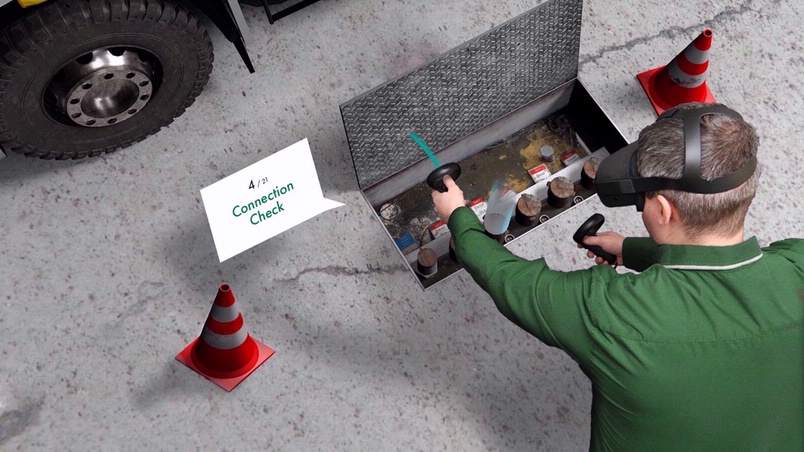

A fully immersive experience can help speed up the pace of learning and improve retention of even some complex concepts. The use of technology can also reduce the cost of purchasing and maintaining expensive equipment for training purposes. Firefighting techniques can also be learned without taking life-threatening risks. Aspiring doctors can now perform complex operations on mannequins and strive for perfection.
Another interesting development is the ongoing research into integrating haptics into the metaverse. A haptic rendering engine combined with the technology’s voice, video and mixed reality capabilities can make the learning experience much greater.
New dimensions for simulations can be reached in the fields of automotive, electronics and biomedical engineering, material design, material synthesis and fine arts.
1. COLLABORATION:
Social interactions are fundamental to human behavior. They also encourage a spirit of learning, cultural understanding and community building. Such partnerships help instill the quality of self-regulation during engagement, which is something elementary schools strive to achieve in children’s formative years.
2. COMMUNICATION:
Talking, reading, writing and listening together make up communication. Previously, these were developed through face-to-face interactions and physical tutoring.
However, replicating it in the Metaverse is a challenge. Therefore, points 1 and 2 in the metaverse shouldn’t pose a problem. Thanks to advanced technologies like AR, VR and more, collaborating and communicating in the virtual world is a breeze!
3. CRITICAL THINKING:
Students often struggle with this vital skill because they are too young to know what to do with the information at hand. Applying knowledge to other areas of life through self-assessment of the pros and cons requires some guidance.
In order for children to reason, they must first learn to collaborate and communicate with each other in order to hear alternative viewpoints, present their own, and make an informed decision.
4. CREATIVE INNOVATION:
Combining the content offered with critical thinking leads to creative innovation in children. This is where content gamification helps, as it not only provides audiovisual aids, but also allows students to visualise what they have learned.
Learning through play also stimulates curiosity, even when it is dormant, which encourages further exploration of the topic. Interestingly, creativity is also the third most sought-after skill for employment, according to the World Economic Forum.
5. CONFIDENCE:
This trait plays a crucial role in making students flexible and persistent. In general, an excessive fixation on achievement leads to a drop in self-confidence and can eventually reduce interest in learning.
When the student is able to use the previous 5Cs comfortably, sixth is second nature. As the virtual world focuses on delivering an immersive experience through cutting-edge technology, developers must focus on the ultimate goal: learning through experience.
BONUS:
6.CONTENT
Traditional learning methods have traditionally involved paper content that often cannot be adapted for personalized learning experiences. In the Metaverse, a combination of collaboration and communication will play a crucial role in determining what content should be offered in the virtual world to best facilitate learning.
CONCLUSION
In conclusion, the college metaverse offers numerous benefits. Immersive learning, better skills, requirement-based skill enhancement, greater access to knowledge, and cost reduction are just the tip of the iceberg.
The Metaverse will revolutionise the higher education segment with virtual classes and hands-on learning. It will eliminate resource scarcity concerns and promote training on hazardous procurement in a risk-free zone.
Quelle:
Foto: Top 5 skills that can be developed using metaverse in higher education