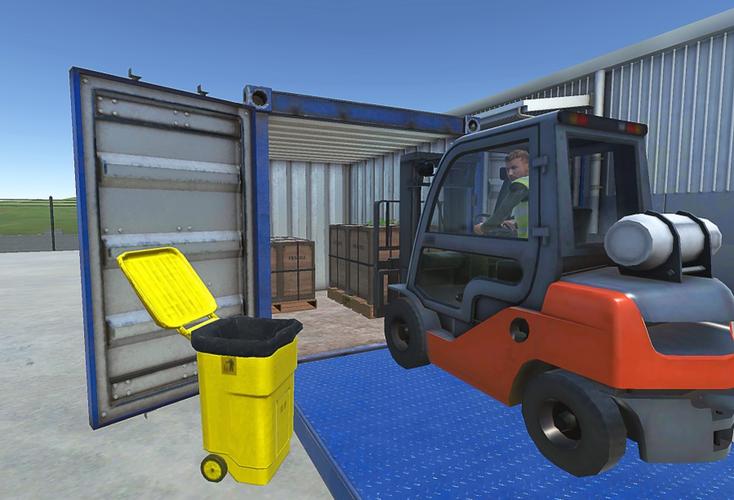
VR could help deliver the NZ Biosecurity 2025 strategy of achieving a biosecurity team of 4.7 million people.
A collaboration between two Hamilton companies is using virtual reality to improve New Zealand’s biosecurity defences by boosting the quality of shipping container inspection.
Independent Verification Services (IVS) in Hamilton has launched a new virtual reality (VR) container inspection simulation which tests and trains inspectors with a series of randomised threats.
The Ministry of Primary Industries has approved the technology, built by Hamilton-based Company-X, to be used in biosecurity refresher training for „accredited persons“ (APs), the people employed to carry out inspections.
New Zealand importers must operate an „approved transitional facility“ to receive, inspect and unpack imported sea containers. In turn, all transitional facilities must have trained and certified personnel,accredited persons, who manage or undertake the different aspects of biosecurity.
Using virtual reality to assess front-line staff dealing with imported goods was a New Zealand first, said IVS chief executive Peter Webb.
It’s the first training course that is not undertaken in a classroom, using a written examination-style assessment,“ Webb said.
„Instead, it offers an online course with a virtual reality assessment that lets trainees demonstrate their practical knowledge and skills.”
The technology provides trainees with a realistic and environment to properly assess their practical abilities to detect and respond to biosecurity threats such as the presence foreign insects and vegetation.
A wireless virtual reality headset allows the person to walk around the simulated container externally and internally, in the same way that they would in the real world.
“The virtual reality tool is the closest and more realistic assessment of skills,” Webb said. “It replicates real-life situations that may be encountered on the job.“
Threats are randomised so trainees experience all of the different scenarios that can happen, Company-X augmented and virtual reality specialist Lance Bauerfeind said.
“We can track head movements so we know where they are looking.”
Webb said the project was the first step in what could be a transformational journey for the biosecurity industry in New Zealand.
“This technology has the potential to be used to educate all New Zealanders to identify and respond
to biosecurity risks,” he said.
“IVS believes virtual reality could be instrumental to achieving a biosecurity team of 4.7 million, where all New Zealanders are aware of the importance of biosecurity and involved in pest and disease management, as set out in the Government’s Biosecurity 2025 strategy.“
The project was led by Bauerfeind, with project manager Dilan Prasad and augmented and virtual reality generalist Wonkee Kim.
Company-X bought Bauerfeind’s Pepper Creative VR studio in June last year.
Quelle:
https://www.reseller.co.nz/article/671635/virtual-reality-deployed-boost-nz-biosecurity-threat-defences/