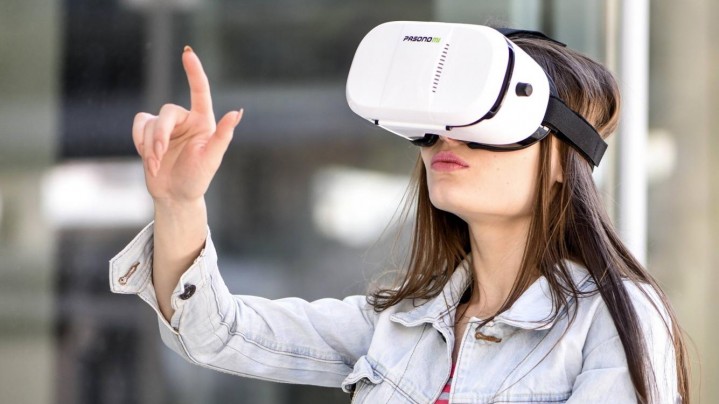
Mit dieser Virtual-Reality-Brille sieht man alles nur noch verschwommen und trüb.

Ein Forschungsteam der Technischen Uni Wien hat eine VR-Brille entwickelt, die den Grauen Star simuliert. Viele ältere Menschen leiden unter dieser Augenkrankheit: Die Linse wird trüber, sie sehen nicht mehr so scharf und kontrastreich, dafür blenden Lichter um so mehr.

Die Forschenden hoffen, dass sich mithilfe ihrer Brille die Probleme, die der Graue Star mit sich bringt, besser verstehen lassen. Das könnte etwa bei der Gebäudeplanung helfen: Die Beleuchtung könnte angepasst werden, um weniger zu blenden, Hinweis- oder Notausgangs-Schilder können so positioniert werden, dass sie trotz der Sehschwäche noch gut erkannt werden.

Die Forschenden wollen ihre Ergebnisse auf der Konferenz IEEEVR2019 in Osaka präsentieren.


Quelle:

https://www.deutschlandfunk.de/augenkrankheit-vr-brille-simuliert-grauen-star.2850.de.html?drn:news_id=988163

Foto: (imago/blickwinkel)

AR – Ist das Kunst oder nur ein Gag?Examples

AR – Ist das Kunst oder nur ein Gag?

Ein Düsseldorfer Park ist gefüllt mit Skulpturen, die nur mit einer App sichtbar sind. AR-Kunst…
27. August 2021
VRrOOm Brings Jarre To Virtual Notre-Dame On NYEKnowledgeResearch

VRrOOm Brings Jarre To Virtual Notre-Dame On NYE

In partnership with the City of Paris and under the patronage of UNESCO, electronic music…
16. Dezember 2020
Passive vs Active Learning: The Cadaver ConundrumExamples

Passive vs Active Learning: The Cadaver Conundrum

Picture this: you are enrolled in an anatomy course, either because you love science or because you had to fill a prerequisite. There are three ways in which you can learn the courseinformation: 1) in the real world, you travel to a cadaver lab as a class, and engage with a dead human being, 2) you listen to a lecture as you look at pictures in a book/computer or watch a video, or 3) you enter into a virtual reality cadaver lab from the comfort of your hometo join your teacher and classmates as you pull organs from a simulated human body, pass them around, and expand them so large that you can step in and examine the arteries, ventricles, cavities, and more. Two of these three are examples of active learning (1 & 3), with the…
17. November 2022

Leave a Reply