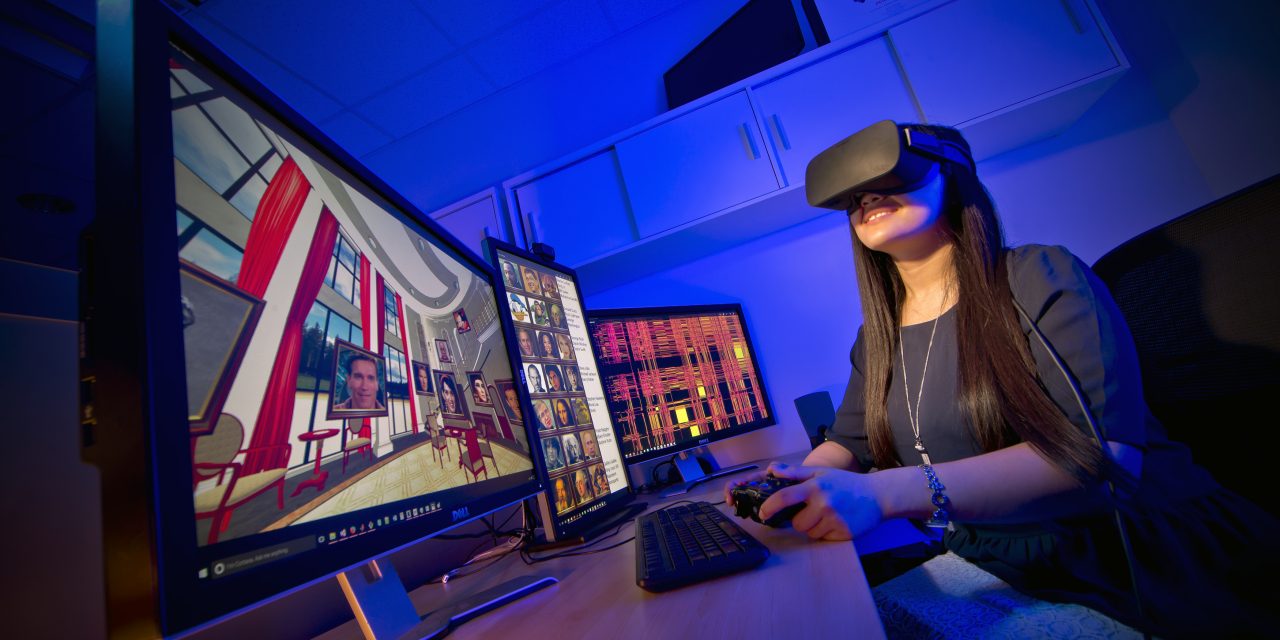
Researchers at the University of Maryland have discovered just how well virtual reality (VR) works as a learning tool. In one of the first in-depth analyses of learning with VR, they conducted a study which took 40 UMD students, most of whom had never used virtual reality before, and compared how each did on two nearly identical memory tests: the only difference being that one was in VR, and other was on a desktop computer. They found there was an almost 9% increase in photos remembered for the VR test, which is statistically significant according to the research team.
“Humans have always used visual-based methods to help them remember information, whether it’s cave drawings, clay tablets, printed text and images, or video,” says Eric Krokos, a doctoral student in computer science and lead author on the paper. “We wanted to see if virtual reality might be the next logical step in this progression.”
The memory test involved remembering the location of a famous person’s photograph inside a digital house, echoing the classic philosophical concept of the memory palace, where memories are “stored” in an imagined physical space, so that they can be more easily recalled later. The team’s findings suggest that people learn better when they can immerse themselves in a world with VR, rather than when they passively look at things on a screen.
“By showing that virtual reality can help improve recall, it opens the door to further studies that look at the impact of VR-based training modules at all levels—from elementary school children learning astronomy to trauma residents acquiring the latest knowledge in lifesaving procedures,” says Amitabh Varshney, professor of computer science and dean of the College of Computer, Mathematical, and Natural Sciences at UMD. “We believe the future of education and innovation will benefit greatly from the use of these new visual technologies.”
Varshney’s comments should come as great news to the students and teachers who will be soon receiving XR kits for their classrooms, and to the VR trainees from Qatar Airways Engines, who codeveloped with Rolls-Royce. The future is bright for training in VR.
Quelle:
https://th3rdeyexr.com/vr-engages-students-more-than-passive-media-study-finds/