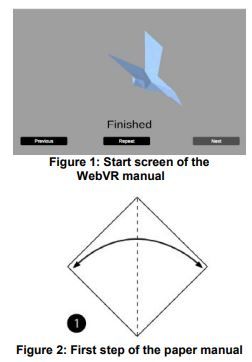
Web Virtual Reality (WebVR) extends the World Wide Web (WWW) in its possibilities by enabling it to present 3D objects. Past research suggests that this could enhance accessibility and calls for further research on user acceptance of this technology. This study conducts an online experiment with a manual for folding an origami figure and compares data from a classic approach versus one where a WebVR manual is presented. Time, quality, knowledge transfer, and motivation are measured, and mediation is tested for usability, cognition, imagination, and comprehensibility. Participants show higher levels of motivation, mediated by comprehensibility and less cognitive effort. The reduced cognitive strain enhances knowledge transfer. Furthermore, the time used is lower in the WebVR setting than in the traditional one. This effect is moderated by usability. Regarding quality, no significant effects are reported.
Link/Quelle: