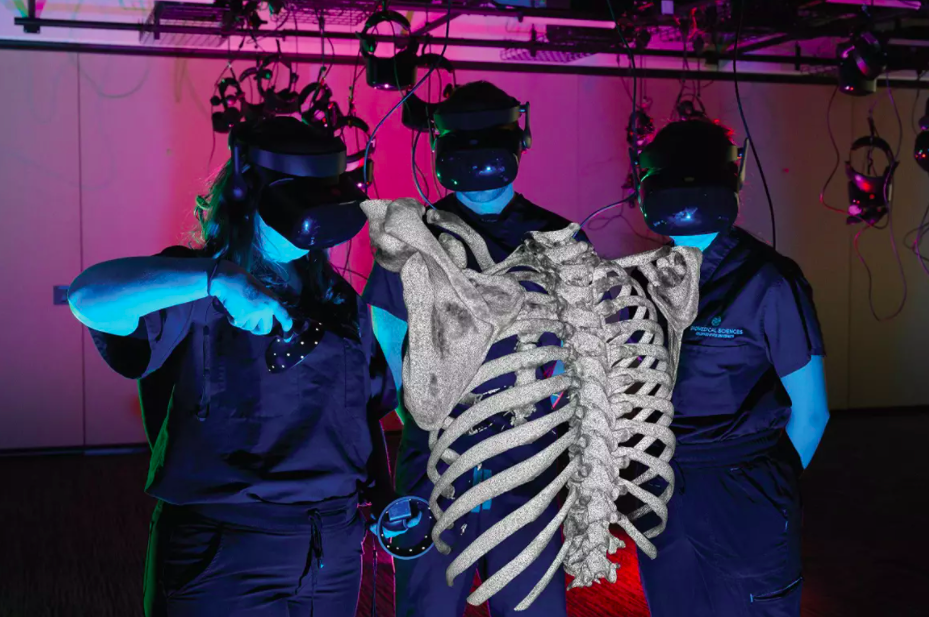
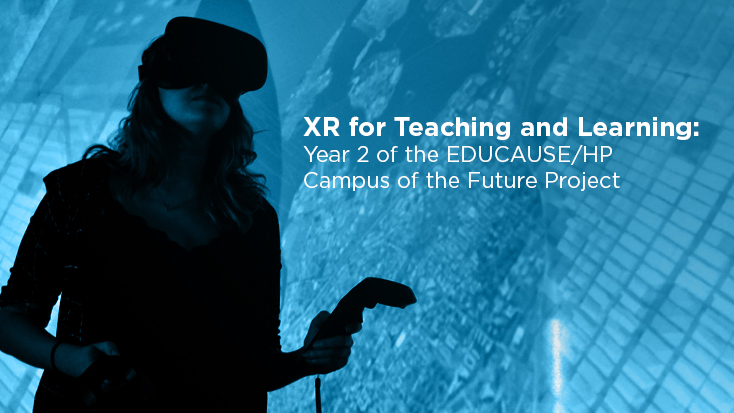
The HP/EDUCAUSE Campus of the Future project is in its second year of investigation into the benefits of augmented reality (AR), virtual reality (VR), and 3D scanning and printing technologies for teaching, learning, and research at the institution.
Read report: HTML | PDF | Executive Summary
Key Findings
This remains one of the broadest, most diverse studies to date of the integration of 3D technologies into higher education. In this year’s report, we build on previous findings to identify types of learning goals that are effectively supported by XR technology, as well as methods for integrating XR into pedagogy to support those learning goals.
In collaboration with HP, 17 institutions were given AR, VR, and 3D printing and scanning technologies, which were utilized in myriad ways to create immersive and innovative learning experiences for students during the 2018-19 academic year. These institutions included returning participants from last year’s study, as well as institutions new to the study this year to further expand our study sample. Through interviews with institutional leaders and staff, as well as supplemental document and artifact analyses, this study offers a number of important findings.
Goals
XR technologies are being used to achieve learning goals across domains. Read more about achieving learning goals >
Uses
Effective pedagogical uses of XR technologies include skills- and competency-based teaching and learning, activities that involve hands-on experience, and experimentation based on new forms of interaction. Read more about effective pedagogical uses >
Integration
Integrating XR into curricula faces two major challenges: time and skills. Read more about curricula integration challenges >
Adoption
The adoption of XR in teaching has two major requirements: the technology must fit into instructors‘ existing practices, and the cost cannot be significantly higher than for the alternatives already in use. Read more about XR adoption requirements >
Effectiveness
The effectiveness of XR technologies for achieving learning goals is influenced by several factors: fidelity, ease of use, novelty, time-on-task, and the spirit of experimentation. Read more about factors influencing effectiveness >
Quelle:
https://library.educause.edu/resources/2019/10/xr-for-teaching-and-learning